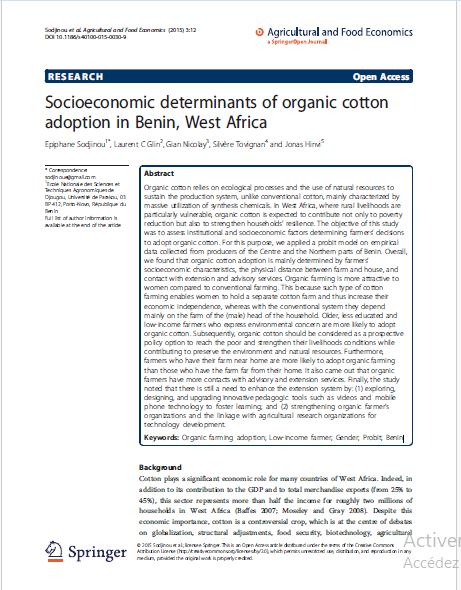
Abstract
Organic cotton relies on ecological processes and the use of natural resources to
sustain the production system, unlike conventional cotton, mainly characterized by
massive utilization of synthesis chemicals. In West Africa, where rural livelihoods are
particularly vulnerable, organic cotton is expected to contribute not only to poverty
reduction but also to strengthen households’ resilience. The objective of this study
was to assess institutional and socioeconomic factors determining farmers’ decisions
to adopt organic cotton. For this purpose, we applied a probit model on empirical
data collected from producers of the Centre and the Northern parts of Benin. Overall,
we found that organic cotton adoption is mainly determined by farmers’
socioeconomic characteristics, the physical distance between farm and house, and
contact with extension and advisory services. Organic farming is more attractive to
women compared to conventional farming. This because such type of cotton
farming enables women to hold a separate cotton farm and thus increase their
economic independence, whereas with the conventional system they depend
mainly on the farm of the (male) head of the household. Older, less educated and
low-income farmers who express environmental concern are more likely to adopt
organic cotton. Subsequently, organic cotton should be considered as a prospective
policy option to reach the poor and strengthen their livelihoods conditions while
contributing to preserve the environment and natural resources. Furthermore,
farmers who have their farm near home are more likely to adopt organic farming
than those who have the farm far from their home. It also came out that organic
farmers have more contacts with advisory and extension services. Finally, the study
noted that there is still a need to enhance the extension system by: (1) exploring,
designing, and upgrading innovative pedagogic tools such as videos and mobile
phone technology to foster learning; and (2) strengthening organic farmer’s
organizations and the linkage with agricultural research organizations for
technology development.
Keywords: Organic farming adoption; Low-income farmer; Gender; Probit; Benin
Socioeconomic determinants of organic cotton adoption in Benin, West Africa
Epiphane Sodjinou, Laurent C Glin, Gian Nicolay, Silvère Tovignan and Jonas Hinvi
16 janv. 2026
Foresterie et Gestion de la Faune
(4.0)
De la même catégorie Foresterie et Gestion de la Faune

Foresterie et Gestion de la Faune