There is a growing interest in food tree species in general, and particularly
indigenous fruit tree species in developing countries. This is because they
are inherent to most tropical landscapes and serve the dual function of local
livelihood support and biodiversity conservation. The main objective of this
study was to provide information for the sustainable management of
Sclerocarya birrea (A. Rich.) Hochst. subsp. birrea (Anacardiaceae) under
present and future climate in Benin. The specific objectives were to assess (i)
the use values, pattern and diversity of use and different knowledge
associated to the species, (ii) the impacts of land use on the population
structure and abundance of the species, (iii) the sex ratio, the relative spatial
repartition of males and females individuals and their implication for the
population dynamics of the species , (iv) the potential for domestication
through study of intra-and-inter-population variability in fruit traits, and (v)
how far climate change can affect the habitat suitability and conservation
status of the species.
Chapter 1 of this thesis describes the general characteristics of the study
species and the geographical features of the study area. Sclerocarya birrea
(is widely distributed in the semi arid areas from Southern Africa through
Eastern Africa and the semi-arid zones of West Africa. That species has
three different subspecies, viz. S. birrea subsp. caffra growing from Southern
Africa to Central Kenya, while S. birrea subsp. birrea is found mainly in
Western, Central and Eastern Africa, and S. birrea subsp. multifoliolata is
endemic to Tanzania. This work has been carried out on Sclerocarya birrea
(A. Rich.) Hochst. subsp. birrea . Owing to its multiple potential, the species
has been considered as one of the most important tree to be domesticated for
rural livelihood improvement in semi-arid Africa but baseline information
relevant to its sound use and management is still scanty.
In chapter 2 (published in 2011) we combined quantitative and qualitative
ethnobotanical approaches to investigate uses and factors affecting the use
value of S. birrea subsp. birrea. Nine group surveys as well as 161
individual interviews were held in the dry and typical Sudanian zones. Seven
different ethnic groups were involved and the survey focused on local uses
and perception of factors affecting the dynamics of the species. S. birrea had
a multitude of uses; all organs were used for more than 20 different
purposes. The results highlighted how far gender, local availability, ethnicity
and community location interact to influence the utilization value of that
species. People living in drier areas with high occurrence of S. birrea use it
more than those living in wetter areas with low occurrence. While domestic
and subsistence uses do not appear to threaten the species, carving, clearing
and drought were the major causes of its decline. Many factors and their
interactions influence the pattern of use of the species within and between
communities. When compared to the level of exploitation of S. birrea subsp.
caffra in southern Africa, the subspecies birrea is at this point relatively
underutilized.
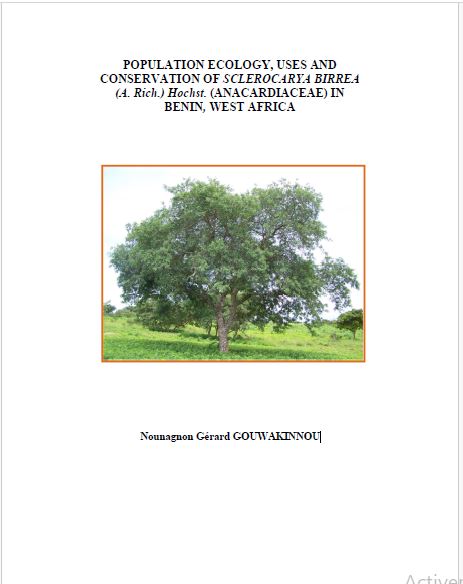
POPULATION ECOLOGY, USES AND CONSERVATION OF SCLEROCARYA BIRREA (A. Rich.) Hochst. (ANACARDIACEAE) IN BENIN, WEST AFRICA
Nounagnon Gérard GOUWAKINNOU
23 janv. 2026
Foresterie et Gestion de la Faune
(4.0)
De la même catégorie Foresterie et Gestion de la Faune

Foresterie et Gestion de la Faune